
Table of Contents
- Why Electrical Panels Catch Fire
- Overloaded Electrical Panels and Circuit Overload
- Loose Connections, Faulty Wiring, and Electrical Arcing
- Electrical Panel Fire Warning Signs You Should Never Ignore
- What to Do If Your Electrical Panel Catches Fire
- Electrical Panel Inspection and Professional Maintenance
- Prevention: How to Reduce Electrical Panel Fire Risk
- Frequently Asked Questions
Last Updated: October 16, 2026
Why Electrical Panels Catch Fire
Electrical panel fires are among the most dangerous threats to home safety. They start silently, often behind walls where you can’t see them, and spread quickly.
Why electrical panels catch fire comes down to three core problems: excessive electrical load, faulty connections, and equipment failure. Each one creates dangerous heat.
Most fires don’t happen by accident. They’re the result of aging infrastructure, poor installation, or gradual deterioration that homeowners never noticed.
Overloaded Electrical Panels and Circuit Overload
An overloaded circuit is one of the most common causes of electrical panel fires. When you plug too many devices into one circuit, you force more current through the wiring than it was designed to handle.
Think of it this way: a 15-amp circuit can safely carry 15 amps of electrical current. Add a microwave, a coffee maker, and a toaster to the same outlet, and you’ve exceeded that limit.
How Overloading Damages Breakers and Wiring
Circuit breakers are safety devices designed to shut off power when current exceeds safe levels. But breakers wear out.
When a breaker fails:
- Current flows unchecked through the circuit
- Wiring temperature rises rapidly
- Insulation breaks down and catches fire
Wiring damage from overloading often happens gradually. You might notice lights flickering or outlets feeling warm to the touch. These are warning signs.
High-wattage equipment is especially dangerous on old circuits. Space heaters, electric dryers, and air conditioning units draw enormous amounts of current.
Loose Connections, Faulty Wiring, and Electrical Arcing
Loose connections are silent killers inside electrical panels. A wire that isn’t fully seated in a breaker terminal creates resistance. Resistance generates heat.
Loose connections happen for several reasons:
- Vibration from appliances loosens terminal screws over time
- Poor installation leaves connections inadequately tightened
- Thermal expansion and contraction cycles gradually work connections loose
Electrical arcing occurs when current jumps across a gap between conductors. The arc temperature exceeds 10,000 degrees Fahrenheit.
Faulty wiring compounds the problem. Damaged insulation, undersized wire, or improper installation creates multiple hazard points.
Electrical Panel Fire Warning Signs You Should Never Ignore
Electrical panel fire warning signs appear before a fire starts. Catching them early gives you time to call for help.
Watch for these specific indicators:
- Burning smell near the panel, a chemical or plastic smell coming from the breaker box is never normal
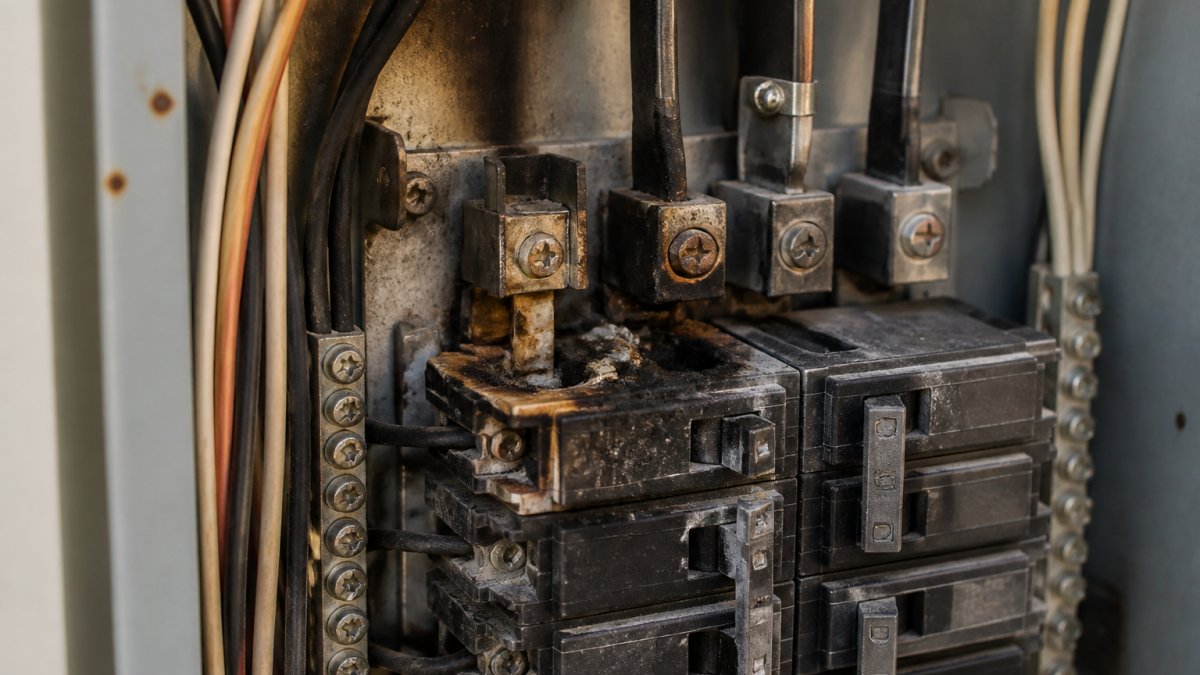
- Visible scorch marks or discoloration, black, brown, or charred areas on the panel exterior or around breakers
- Warm or hot panel cover, the breaker box should be cool to the touch
Any of these signs means you need a professional inspection immediately. Do not ignore them. Do not wait.
What to Do If Your Electrical Panel Catches Fire
A panel fire is a structural emergency, not a household nuisance. The fire travels along conductors inside the walls, so by the time you see flame at the panel, the fire has often already moved into concealed spaces. Your decisions in the first 60 seconds matter more than anything else in this article.
Immediate Actions and Evacuation
The single most important rule: do not touch the panel. A panel that is arcing or burning may still be energized. Touching the dead front, the breaker handles, or the panel enclosure can complete a circuit through your body. There is no safe way to open a burning panel.
Do this, in order:
- Leave the building immediately. Do not stop to investigate, grab documents, or shut off the main breaker. The main breaker may already be compromised, and reaching for it puts you directly in the arc path.
- Move everyone out, including pets. Account for every person before you call. A second trip inside is how most fire injuries happen.
- Call 911 from outside. Tell the dispatcher it is an electrical fire at the panel. That single phrase changes how the fire department approaches the scene, they may isolate power before applying water.
- Do not re-enter for any reason. Electrical fires re-ignite in wall cavities after the visible flame is out. Only the fire department can confirm the fire is extinguished.
- Stay clear of windows and doors. Stand well back from the structure. Panels are often mounted on exterior walls or in garages, and a failing panel can vent flame and molten metal outward.
If you smell burning plastic but see no flame, treat it as a fire in progress. Burning insulation odor means the wire is already hot enough to be off-gassing. Evacuate and call 911, do not open the panel to look.
When to Use a Fire Extinguisher, and When Not To
Most homeowners reach for the wrong extinguisher. Here is the distinction that matters:
- Water (Class A) extinguishers are lethal on a panel fire. Water conducts electricity. A stream of water into an energized panel can electrocute the person holding the extinguisher and anyone standing in the water.
- Foam extinguishers leave conductive residue and are not rated for energized electrical equipment.
- Only a Class C extinguisher is rated for energized electrical fires. Class C is a rating, not a chemical, you will usually see it printed as “A-B-C” or “B-C” on a multipurpose dry chemical unit. The dry chemical agent is non-conductive.
Even with a Class C extinguisher, fighting a panel fire is usually the wrong call. Use it only if all of the following are true:
- The fire is small, no larger than a wastebasket, and still confined to the panel itself
- You have a clear, unobstructed escape route directly behind you
- The fire has not reached walls, insulation, or the ceiling above the panel
If any one of those conditions is not met, evacuate and let the fire department handle it. A panel fire that has spread into a wall cavity cannot be extinguished with a handheld extinguisher, and staying to try is how people die.
Evacuate first, call 911 second, and only consider a Class C extinguisher if the fire is tiny, contained, and you have a clear exit. Never use water or foam on an energized panel.
Electrical Panel Inspection and Professional Maintenance
A professional electrical panel inspection catches problems before they become fires. An electrician checks:
- Breaker connections for tightness and corrosion
- Wiring for damage, improper installation, or deterioration
- Panel temperature and heat distribution
How often should you have your panel inspected? If your home is over 20 years old, inspect it every 3-5 years. If you’ve experienced flickering lights, tripping breakers, or a burning smell, get an inspection immediately.
Farrell Electric & Solar performs comprehensive electrical inspections that identify hazards before they cause fires. If upgrades are needed, we explain exactly why and what the options are.
Prevention: How to Reduce Electrical Panel Fire Risk
Most panel fires are preventable, but prevention only works if you know which risk factors apply to your home. The checklist below is organized by the four factors that drive most panel fires: age, installation quality, electrical load, and signs of prior damage.
Risk Factor 1: Age of the Panel and Wiring
Electrical equipment has a service life. Insulation dries out and becomes brittle. Breaker mechanisms lose calibration. Terminal screws loosen from decades of thermal cycling.
- Panels 40 years or older are past their expected service life and should be evaluated for replacement, not just repair.
- Homes built before the mid-1970s may still have aluminum branch-circuit wiring, which expands and contracts differently than copper and loosens at terminations over time.
- Certain panel brands are known hazards. Federal Pacific Electric (FPE) Stab-Lok panels and Zinsco panels have a documented history of breakers that fail to trip under overload. If you have one, replacement is the standard recommendation, not a repair.
Risk Factor 2: Installation Quality
Poor workmanship is one of the most common root causes of panel fires, and it is invisible until something fails.
- Double-tapped breakers, two wires under one terminal screw, are a frequent finding and a common source of loose, high-resistance connections.
- Undersized wire on a circuit rated for more current than the wire can carry will overheat before the breaker trips.
- Missing or improperly sized grounding and bonding can leave fault current with nowhere safe to go.
Risk Factor 3: Electrical Load
Modern homes draw far more current than the panels installed decades ago were designed to supply.
- Do not daisy-chain extension cords or power strips. Plugging a strip into a strip is a classic overload setup.
- Distribute heavy loads across circuits. Space heaters, electric dryers, ranges, water heaters, and air conditioners each belong on a dedicated circuit.
- Add dedicated circuits before adding appliances. Before installing a hot tub, EV charger, or second refrigerator, have an electrician verify the panel has capacity.
- Solar and battery storage add load and backfeed. A panel that was marginal before solar may be unsafe after it.
Risk Factor 4: Signs of Prior Damage
Damage rarely appears suddenly. It accumulates.
- Scorch marks, discoloration, or a melted breaker face mean heat has already occurred at that point.
- A warm panel cover or warm breaker handles indicate resistance heating inside.
- Repeated breaker trips mean the breaker is doing its job, or failing to. Either way, it needs diagnosis.
- Rust or moisture inside the panel corrodes terminals and increases resistance.
What a Professional Inspection Actually Checks
A licensed electrician inspecting a panel is not just looking at it. The inspection typically includes:
- Thermal scanning of breakers and terminations to find hot spots that are invisible to the eye
- Torque checks on terminal screws, since a loose connection is the most common fire precursor
- Load calculation to confirm the panel’s capacity matches the home’s actual demand
- Breaker testing to confirm each breaker trips within its rated curve
If the inspection finds a loose connection or a single failed breaker, repair may be enough. If it finds a recalled panel brand, widespread aluminum wiring, or a panel already at capacity, replacement is usually the safer and more cost-effective path.
Keep a written record of every inspection, repair, and panel upgrade. When you sell the home, that record is proof the electrical system has been maintained, and it helps the next electrician understand what they are working on.
Consumer product safety recall database for electrical panels and breakers
Frequently Asked Questions
What are the most common warning signs before an electrical panel catches fire?
Watch for burning smells near your electrical panel, visible scorch marks or discoloration around breakers, frequent circuit breaker tripping, flickering lights, or buzzing sounds from the panel. Hot spots on the panel casing or melted plastic around connections are serious red flags. If you notice any of these, stop using circuits on that panel and call a licensed electrician immediately. Don’t wait, these signs indicate dangerous electrical arcing or overheating that can ignite without warning.
Can an overloaded electrical panel catch fire?
Yes. An overloaded electrical panel forces excessive electrical current through wires and breakers designed for lower loads. This causes wires to overheat, insulation to break down, and breakers to fail. When a breaker cannot trip properly or is bypassed, heat builds rapidly, melting wire insulation and igniting surrounding materials. Overloading is one of the leading causes of electrical panel fires. If your breakers trip frequently or you’re using multiple extension cords and high-wattage equipment, your panel is likely overloaded and needs professional evaluation.
What should I do if my electrical panel is smoking or sparking?
Evacuate immediately and call emergency services from outside your home. Do not attempt to extinguish an electrical panel fire yourself, water conducts electricity and will make it worse. Turn off the main breaker only if you can reach it safely without smoke or heat exposure. Leave the property and let firefighters handle it. After the emergency, a licensed electrician must inspect the entire system before you use electricity again. Electrical panel fires spread quickly and produce toxic smoke, so prioritize safety over property.
How often should I have my electrical panel inspected?
The National Electrical Code recommends a professional electrical panel inspection every 3-5 years for residential homes, or immediately if you notice warning signs. Older panels (30+ years) should be inspected annually. A licensed electrician will check for loose connections, corrosion, proper breaker operation, signs of overheating, and compliance with current electrical codes. Regular inspections catch dangerous conditions before they cause fires. If you’ve had recent electrical work, additions, or high-demand appliance installations, schedule an inspection within a few months to ensure your panel can handle the load safely.